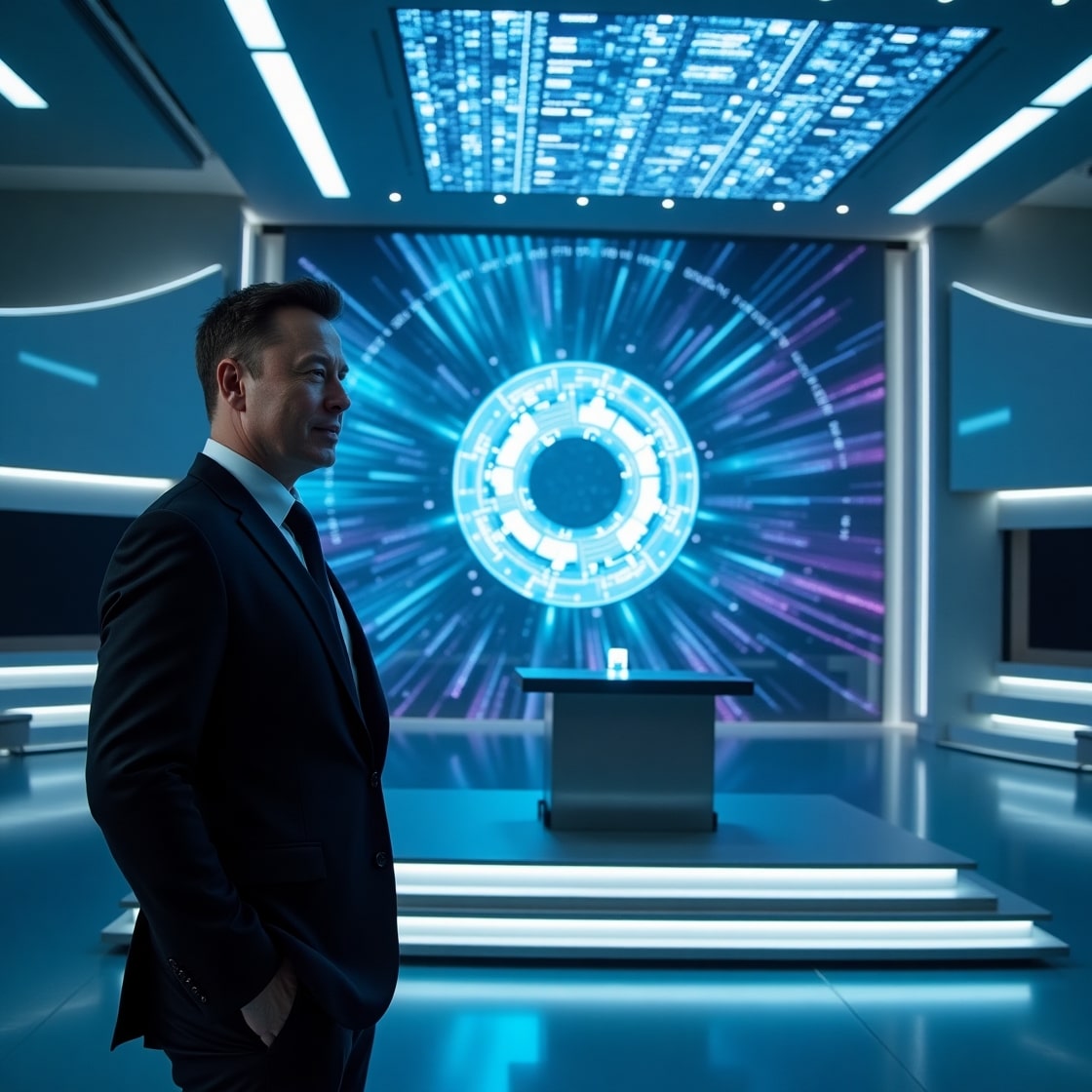
Elon Musk AI 2025 is no longer just a concept it’s reshaping how the world understands artificial intelligence globally. Musk has a way of upending things, whether it’s creating electric vehicles, launching rockets, or now entering the artificial intelligence space. And he’s doing it once more in 2025. From Tesla and SpaceX to Neuralink and now his newest AI startup, xAI, Musk isn’t just involved in the future; he’s helping to create it. So, what exactly is he doing this time around? And how is it different from what others in tech are doing? Let’s dive in.
xAI and Elon Musk AI 2025: A New Challenger in Artificial Intelligence
Elon Musk’s latest company, xAI, is his big move into artificial intelligence. You might’ve heard about Grok, the chatbot he launched through X (formerly Twitter). It’s a little more sarcastic and a bit more rebellious than ChatGPT or Google’s Gemini, and that’s kind of the point.
Musk says he wants AI that’s based on “truth-seeking,” not overly filtered or politically correct. With xAI, he’s trying to build a system that offers real, uncensored responses and thinks critically, not just mimicking the internet.
While companies like OpenAI and Anthropic focus on safety and alignment, Musk is going for something bolder: AI that questions, jokes, and maybe even challenges its users. With the launch of xAI, Elon Musk AI 2025 becomes a bold attempt to redefine chatbot behavior and transparency.
Tesla’s Role in Elon Musk AI 2025: Self-Driving and Dojo Supercomputing
We often think of Tesla as just an electric car company, but it’s becoming one of the most important players in AI and robotics. The company’s self-driving software is built on powerful neural networks, trained on millions of miles of real-world driving data.
Tesla’s Full Self-Driving (FSD) tech is about more than getting from A to B; it’s about creating a machine that can see, decide, and act like a human driver. Behind the scenes, Tesla uses its in-house Dojo supercomputer to train its models faster and more efficiently than ever.
And then there’s Optimus, Tesla’s humanoid robot. It’s still early days, but Musk says it could eventually handle dangerous, repetitive, or boring tasks like a physical version of AI for the real world.
Neuralink in Elon Musk AI 2025: Where Human Brain Meets Machine
Neuralink, a company that seeks to establish direct connections between computers and the human brain, may be Musk’s most futuristic endeavor. Initially, it is intended to help people
With neurological disorders, think of it as a way to restore movement or vision, but in the long run, it may be used to help people keep up with artificial intelligence.
Imagine having the ability to use your thoughts to operate your phone, vehicle, or even your robot assistant. Neuralink is working on a future like that. Musk says it’s closer than we realize, even though it sounds like science fiction.
SpaceX, Starlink, and Elon Musk AI 2025: Powering the AI Infrastructure
AI isn’t limited to data centers and smartphones. For it to function properly everywhere, fast, worldwide internet is required. SpaceX’s satellite internet network, Starlink, can help with that.
Starlink has the potential to serve as the basis for future AI-powered tools, smart devices, and even autonomous systems like drones or delivery bots by delivering high-speed internet to even the most remote regions of the world.
In the meantime, SpaceX itself depends significantly on automation and machine learning to safely launch rockets and return them to Earth, something that would have seemed unthinkable only ten years ago.
Elon Musk AI 2025 and the Push for Unfiltered, Truth-Seeking AI
Musk has always had strong opinions about AI safety. He’s warned about the dangers of superintelligent machines more than once, even calling for regulation and oversight. But interestingly, he also criticizes current AI models for being too “woke” or politically biased.
With xAI, he’s trying to build a model that answers truthfully even if it’s controversial or uncomfortable. It’s a delicate balance between freedom of expression and ethical responsibility, and Musk seems to prefer a less restricted approach than many of his peers.
How xAI Stands Out from the Crowd
There are a lot of big names in AI right now. OpenAI (ChatGPT), Google DeepMind (Gemini), Anthropic (Claude), and Meta (LLaMA). So why does Musk think we need one more?
His answer: none of the current models are truly honest, transparent, or fearless enough.
xAI is built using data from X, Tesla, and possibly even Starlink in the future. It could tap into real-time information, use Tesla’s supercomputing power, and train on fresh, global datasets. Musk sees this as a major advantage in building smarter, more capable AI systems.
What’s Next? Mars, Robots, and Human-Machine Merging
Typically, Elon Musk doesn’t aim low. His long-term goals consist of
- Robots that work in factories, perform your household tasks, and even be your friends
- AI tools that support human habitation of Mars
- Neural interfaces that allow humans to “merge” with machines in order to stay ahead of artificial general intelligence (AGI)
Although it’s a bold plan, if Musk’s history is any guide, at least some of it might come to pass.
Final Thoughts: The Musk Effect on the Future
There is no doubting that Elon Musk continues to influence the tech industry in ways that few others can, regardless of your feelings toward him. He makes trends rather than merely following them. Similar to cars and rockets, he is pushing the envelope and questioning conventions in AI. Even though not every idea will work out exactly as expected, Musk’s unwavering ambition is pushing the sector to advance more quickly, think more deeply, and take more chances. The world is watching as Elon Musk once again shapes the future of artificial intelligence and technology, for better or worse. As Elon Musk AI 2025 reshapes the tech world, those watching closely may find themselves at the edge of the next big leap