
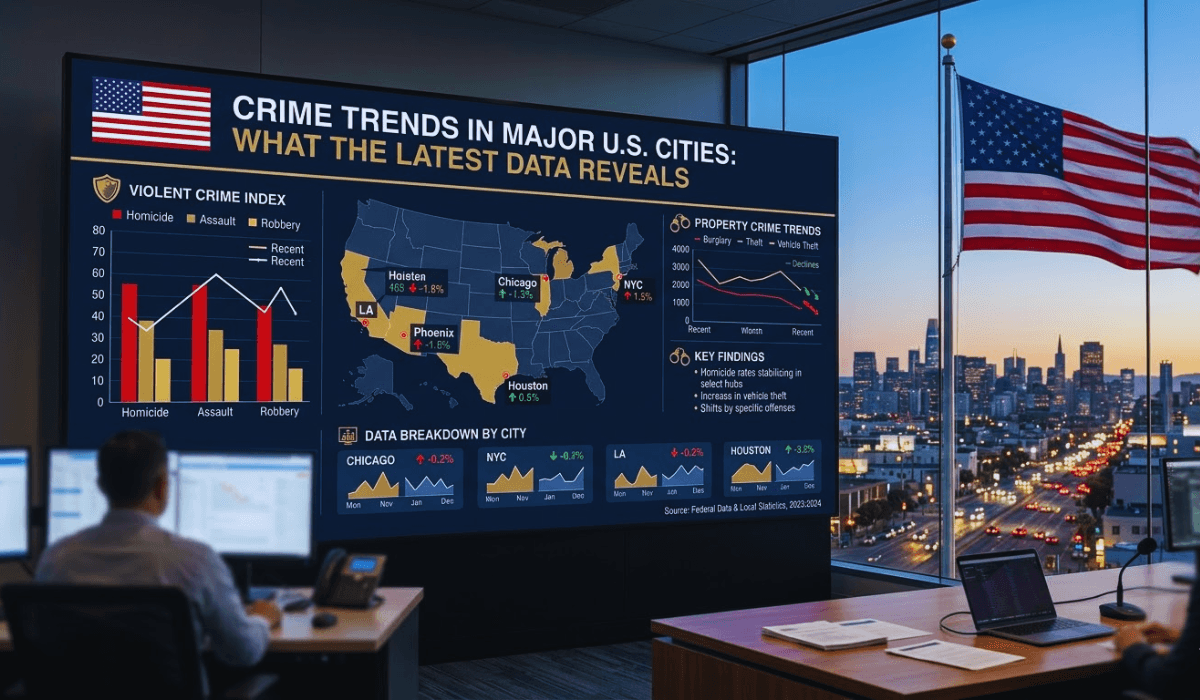
National Crime Statistics: What the Latest Data Shows
Recent data from the Federal Bureau of Investigation (FBI) indicates that overall violent crime in the United States has declined in recent years. According to national crime statistics, violent crime decreased by approximately 4.5% in 2024 compared with 2023 levels, marking the second consecutive year of decline. Property crimes also dropped by more than 8%, including decreases in burglary and motor-vehicle theft.
The FBI estimates that a violent crime occurred roughly every 26 seconds in 2024, highlighting both the scale of criminal activity and the ongoing need for effective law enforcement strategies. FBI crime data shows that murder rates and other violent offenses have declined significantly compared with pandemic-era peaks.
Research organizations also report similar trends. Data compiled from dozens of major cities shows that homicides fell sharply in 2025, with some cities recording one of the largest single-year declines in decades.
Crime Patterns in Major Cities
Although national trends show improvement, crime patterns vary significantly across major urban areas such as New York City, Chicago, Los Angeles, and Houston. Population size, economic conditions, policing strategies, and social programs all influence crime levels.
Large metropolitan areas tend to report higher crime totals simply because of their population density. However, when adjusted for population, some mid-sized cities experience higher crime rates than the nation’s largest metropolitan centers.
Cities such as Memphis, St. Louis, and Cleveland frequently appear near the top of national rankings for violent or property crime rates. Factors such as poverty levels, economic inequality, and limited access to social services can contribute to higher crime levels in these regions.
Recent Crime Incidents Highlight Urban Challenges
Recent events illustrate the ongoing challenges faced by law enforcement agencies across the country. In early 2026, authorities investigated a mass shooting at a bar in Austin, Texas, that left two people dead and more than a dozen injured. The FBI joined the investigation as officials examined possible extremist motivations behind the attack.
Meanwhile, some cities are experiencing localized increases in specific types of crime. For example, New York City recently saw transit-related crime increase by nearly 20% during a winter period when enforcement actions inside the subway system were temporarily reduced due to extreme weather conditions.
However, despite these isolated spikes, broader citywide statistics often show declining crime rates. Officials in New York reported record-low numbers of shootings and murders during the same period, reflecting the impact of targeted policing strategies.
Signs of Progress in Urban Crime Reduction
Several major cities are reporting notable progress in reducing violent crime. In Allegheny County, Pennsylvania—home to Pittsburgh—officials reported that homicides dropped to an 18-year low in 2025, with only 65 cases recorded across the region. Local leaders credit violence-prevention programs, increased police resources, and social service investments for the improvement.
Similarly, national crime analyses indicate that violent offenses such as aggravated assault, robbery, and gun violence are falling in many large cities. Reports show approximately 9% fewer aggravated assaults and 23% fewer robberies compared with previous years in several major urban areas.
Experts say that the combination of community policing, targeted enforcement strategies, and investments in prevention programs has contributed to these improvements.
The Role of Law Enforcement and Policy
Law enforcement agencies across the United States are increasingly relying on data-driven policing strategies. These approaches use crime statistics, geographic analysis, and predictive technology to identify high-risk areas and allocate police resources more effectively.
Federal programs such as the FBI’s Uniform Crime Reporting system provide standardized data that allows cities and policymakers to monitor crime trends nationwide. This information helps law enforcement agencies identify patterns and implement targeted crime-prevention strategies.
At the same time, policymakers are investing in prevention programs that address the root causes of crime. Community outreach initiatives, youth education programs, and mental-health services are increasingly recognized as essential components of long-term crime reduction.
Public Safety and Community Engagement
Public safety efforts increasingly emphasize collaboration between law enforcement and communities. Many cities are expanding neighborhood policing programs that encourage residents to work closely with officers to report suspicious activity and prevent crime.
Community organizations also play a critical role in violence prevention. Programs that focus on youth mentorship, job training, and conflict mediation have been shown to reduce crime in several cities. Local governments are also investing in technology such as surveillance systems, gunshot detection networks, and crime analytics platforms to enhance public safety.
Conclusion
Crime trends in major U.S. cities are complex and constantly evolving. While certain types of crime and localized incidents continue to attract attention, the broader national data shows encouraging progress. Violent crime rates have declined in many cities, and new strategies combining law enforcement, technology, and community engagement are helping improve public safety.
However, experts caution that sustained investment in policing, social programs, and economic development will be necessary to maintain these improvements and address ongoing challenges in urban communities. As crime trends continue to change, staying informed about reliable data and credible news sources remains essential for understanding public safety in America’s largest cities.
For more updates on U.S. politics, crime, and national developments, visit World Stage Today.
